What Qualifies as Like-Kind Property in a 1031 Exchange?
An IRS-based guide to eligible real estate, common exclusions and the steps to take before selling.

Source check: September 9, 2026. This article explains existing IRS guidance; it does not announce a new tax law or an IRS endorsement.
Like-kind property in a 1031 exchange generally means real estate held for investment or business use exchanged for other qualifying real estate. The buildings do not have to look alike or serve the same commercial purpose. However, personal-use property, real estate held primarily for sale, and an exchange of U.S. property for foreign property do not meet these basic requirements. IRS: Like-kind exchanges — Real estate tax tips
For an investor, the practical question is often: Can I sell the property I own and buy a different kind of investment property without recognizing all of the gain immediately?
The answer can be yes. But eligible property is only one part of a qualifying exchange. How you hold the property, how the transaction is arranged, when you identify and acquire the replacement, and whether you receive cash also matter.
What does “like-kind” actually mean?
The IRS looks at the nature or character of the real property, rather than whether the two properties have the same grade or quality. Improved and unimproved real estate can be like-kind. IRS Publication 544 specifically describes exchanges of city property for farm property and improved property for unimproved property. IRS Publication 544: Like-kind exchanges
That distinction gives investors flexibility. Selling a rental house does not automatically mean the replacement must be another rental house. An investor may be able to exchange into commercial real estate or land held for investment, provided the specific property interests and the rest of the exchange satisfy Section 1031.
The property category can change. The qualifying investment or business purpose still matters.
Which properties can qualify? Examples at a glance
The examples below illustrate the general federal like-kind property rules. They are not approvals of individual transactions. For potentially qualifying examples, assume both properties are in the United States and held for the required investment or business purpose.
| Property being exchanged | Proposed replacement | General treatment |
|---|---|---|
| Rental house | Apartment building | Potentially qualifying; identical building types are not required. |
| Apartment building | Commercial building | Potentially qualifying; residential-to-commercial is not automatically disqualified. |
| Improved investment property | Unimproved investment land | Potentially qualifying; land does not have to contain a building. |
| Investment real estate in New York | Investment real estate in another U.S. state | Potentially qualifying under federal like-kind rules; separately review state tax treatment. |
| Primary residence used only as a home | Rental property | The personal-use home does not qualify under Section 1031. |
| Property held primarily for resale | Long-term rental property | The relinquished property's resale purpose prevents it from qualifying. |
| U.S. investment property | Property outside the United States | U.S. and foreign real estate are not like-kind to each other. |
| Standalone equipment, vehicles or artwork | Other equipment, vehicles or artwork | Generally outside current Section 1031 like-kind treatment. |
Sources: IRS real estate tax tips, Publication 544, and Form 8824 instructions.
What does not qualify for a 1031 exchange?
Property used only for personal purposes
A home used solely as your primary residence is not business or investment property for Section 1031 purposes. A separate provision, Section 121, may apply to gain on the sale of a main home. Mixed-use properties and properties converted between personal and rental use need their own analysis; a change of label alone does not establish eligibility. IRS Form 8824 instructions: Property Used as Home
Real estate held primarily for sale
Section 1031 excludes real estate held primarily for sale. A property acquired and held as resale inventory is different from one held for rental income or investment appreciation. The intended use of the replacement does not cure an ineligible relinquished property. IRS real estate tax tips
Most personal and intangible property
For exchanges under the current rules, Section 1031 applies to qualifying real property. Standalone vehicles, artwork and equipment generally do not qualify. Certain fixtures and real-property interests require closer classification, so an investor selling a furnished or operating property should not assume every asset in the sale receives the same treatment. IRS Form 8824 instructions: Definition of Real Property
Does a 1031 exchange eliminate the tax?
A qualifying 1031 exchange generally defers recognition of gain; it does not simply erase the gain. The tax basis carried into the replacement property helps preserve the deferred gain for a later taxable disposition. IRS Publication 544
This matters when comparing two investment choices. A deferral can allow more capital to remain invested, but the replacement property's operating costs, financing, vacancy risk and suitability still deserve an independent review. Tax treatment is one part of the decision.
What if you receive cash or other property?
Cash or non-like-kind property received in an exchange is often called boot. It can produce recognized gain, generally limited by the gain realized in the exchange. Debt relief can also affect the calculation. IRS Publication 544: Partially Nontaxable Exchanges
Assume an otherwise qualifying exchange produces $150,000 of realized gain and the investor receives $20,000 in cash. Ignoring debt, exchange expenses and other adjustments, $20,000 would generally be recognized and $130,000 deferred. The $20,000 is the amount of recognized gain in this simplified example—not the tax bill. This is an illustration, not a client result. IRS Publication 544
Before agreeing to keep cash or change the financing structure, have your tax adviser calculate the effect.
What are the deadlines for a delayed 1031 exchange?
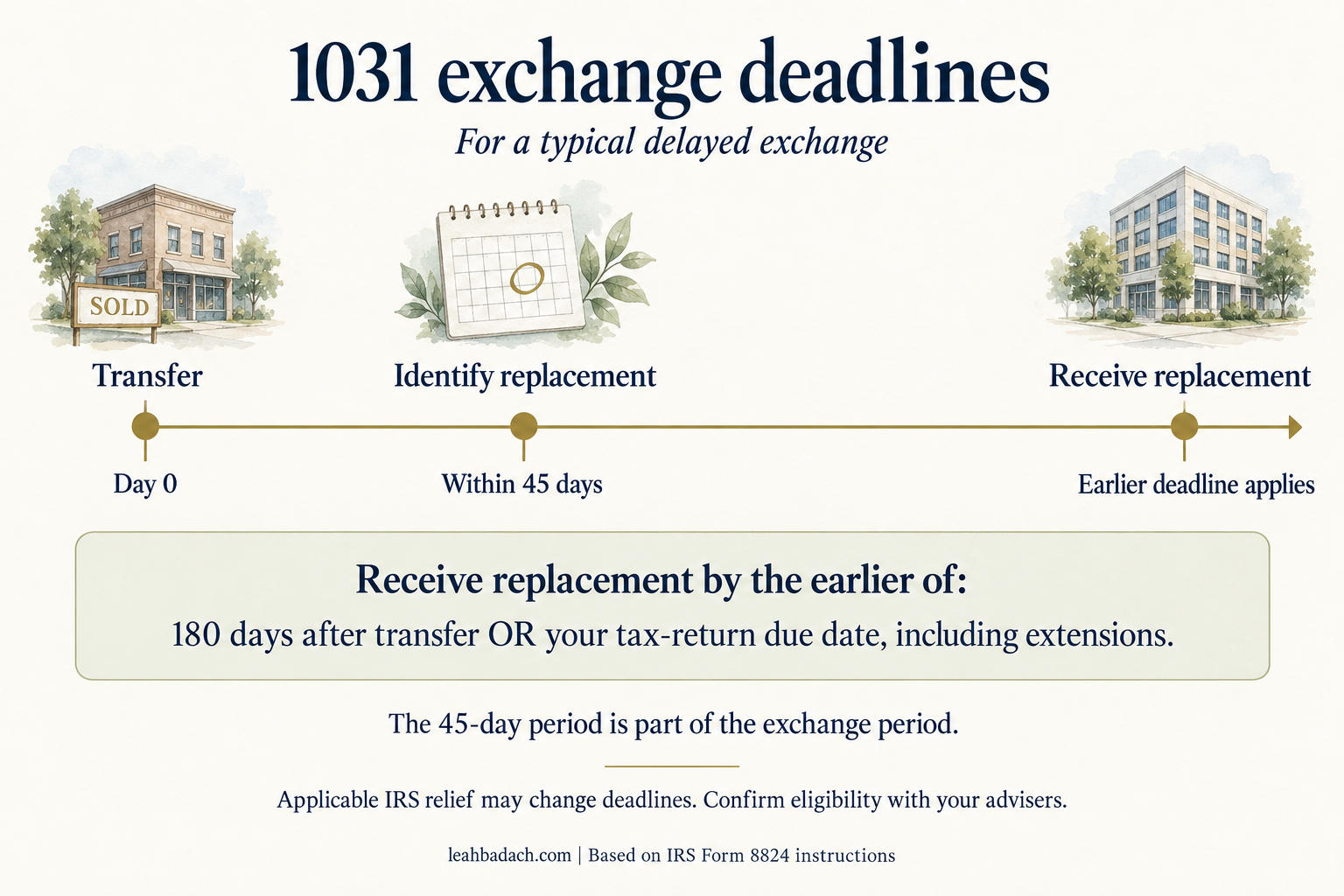
In a typical delayed exchange, the replacement property arrives after the relinquished property is transferred. The IRS specifies two timing requirements:
| Requirement | General deadline |
|---|---|
| Identify replacement property | Within 45 days after transferring the relinquished property, following the applicable written-identification rules. |
| Receive replacement property | By the earlier of 180 days after that transfer or the due date of the tax return for the transfer year, including extensions. |
The 45-day identification period is inside the exchange period. You do not receive 45 days plus another 180 days. The tax-return deadline can also shorten the available exchange period, so a year-end sale warrants a discussion with your tax preparer about filing deadlines and extensions. IRS Form 8824 instructions: Deferred Exchanges and Lines 5–6
Applicable IRS disaster relief can postpone certain exchange deadlines for eligible taxpayers or transactions. Do not assume an extension applies simply because a disaster has occurred; verify the specific notice and eligibility conditions with your advisers. IRS Revenue Procedure 2018-58, Section 17
Can you receive the sale proceeds and arrange the exchange afterward?
Do not assume you can deposit the sale proceeds in your own account and later turn the sale into a tax-deferred exchange. Actual or constructive receipt of proceeds can prevent the intended deferred-exchange treatment. The exchange structure and restrictions on access to funds need attention before the relinquished-property closing. IRS Publication 544: Deferred Exchanges
A qualified intermediary arrangement is a commonly used safe harbor. The intermediary's eligibility, written agreement and handling of the exchange must satisfy the relevant rules. A QI is not interchangeable with any person willing to hold the money. IRS Form 8824 instructions: Deferred Exchanges
Read more about the qualified intermediary's role.
A New York investor's example: different buildings, separate questions
Consider an investor who owns a Brooklyn rental building and is exploring investment real estate in another U.S. state. The proposed replacement is a commercial property rather than another residential building.
The difference in building type is not, by itself, the obstacle. Under the IRS's broad real-estate like-kind framework, the investor should instead investigate qualifying use, the property interests involved and the transaction requirements. IRS real estate tax tips
Before moving forward, a useful planning conversation would cover:
- How the current property has been used and documented.
- How the replacement will be held and operated.
- Who will own each property and sign the exchange documents.
- Whether the identification and acquisition dates work.
- Whether cash, financing or transaction expenses affect the tax result.
- What state-specific advice and reporting are needed.
This example describes a planning situation, not a completed exchange or a guaranteed outcome. Federal eligibility should not be mistaken for a completed analysis of state taxes.
How do you report a like-kind exchange?
The IRS uses Form 8824, Like-Kind Exchanges, to report the transaction. The form addresses the exchanged properties, relevant dates, gain and the basis of replacement property. A qualifying exchange can still have a reporting requirement even if no gain is currently recognized. IRS: About Form 8824
Give your tax preparer the exchange agreement, closing statements, identification documents, acquisition dates and supporting basis records. Use the form and instructions applicable to your filing year. The IRS instructions available when this article was prepared were labeled 2025; consult the IRS form page for later revisions.
Questions to answer before your sale closes
Use this checklist to prepare for a conversation with your exchange professional and tax adviser:
- Property use: Is the property held for investment or business, rather than personal use or primarily for resale?
- Replacement goal: What do you want the next property to accomplish—different management demands, location or property type?
- Transaction structure: Have the exchange documents and funds-handling arrangements been established before closing?
- Dates: What are the written-identification deadline and the actual acquisition deadline, including the tax-return rule?
- Tax calculation: What are the adjusted basis, liabilities, expected cash received and exchange expenses?
- Records: Who is gathering the documentation your tax preparer needs for Form 8824?
Planning to sell an investment property? Build your 1031 exchange plan to share your property and timing with Leah Badach. Bring your tax adviser into the conversation before closing so the property search and exchange structure can be evaluated together.
Frequently asked questions
Can I exchange a rental house for commercial property?
Generally, yes, if both properties and the transaction meet the Section 1031 requirements. The like-kind test does not require an identical building type. Qualifying investment or business use remains essential. IRS real estate tax tips
Can vacant land qualify as replacement property?
Yes, land held for investment or business use can qualify. The IRS recognizes that improved and unimproved real estate can be like-kind. Land held primarily for sale is excluded. IRS Publication 544
Must the replacement property be in the same state?
No. The federal like-kind requirement does not require the same state. U.S. real property and foreign real property are not like-kind to each other. An interstate transaction still needs separate state-tax analysis. IRS Publication 544
Does buying another property within 180 days make a sale a 1031 exchange?
No. Timing alone is insufficient. Qualifying property, the exchange arrangement, identification and proceeds-handling rules also matter. The acquisition deadline can be earlier than day 180 because of the tax-return due-date rule. IRS Form 8824 instructions
Is this an announcement of new IRS rules?
No. This is an explanation of the IRS's existing like-kind exchange guidance, supplemented by its reporting instructions and Publication 544. The source-check date shows when the materials were consulted, not when Congress or the IRS changed the law.
Planning a sale and want the eligibility questions answered first?
Share the property, the timing and what you are considering next. The form sends Leah your details so she can get back to you; it does not book an appointment by itself.
Build your 1031 exchange planThis article provides general information about federal like-kind exchange rules. It is not individualized tax, legal or investment advice. Your tax adviser and attorney should evaluate your transaction, including state-specific requirements.